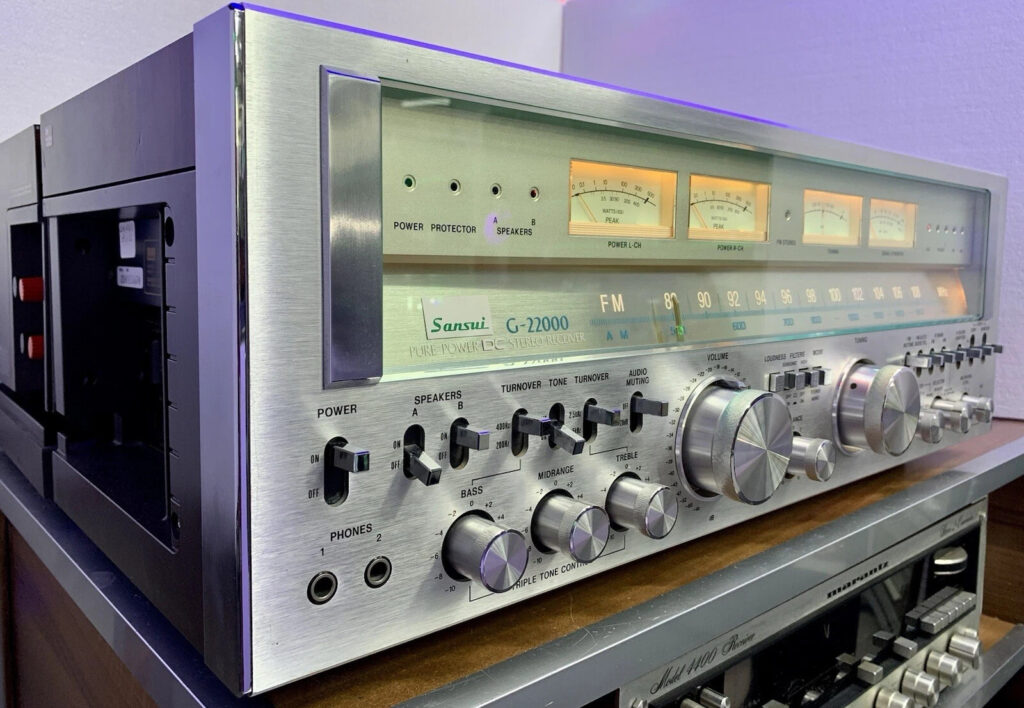
Vintage stereo explained shouldn’t require an electrical engineering degree.
Watts.
Ohms.
THD.
Impedance.
Ground wires.
Phono inputs.
Clipping.
We vintage stereo people throw these words around like everyone was born knowing what they mean.
They weren’t.
I wasn’t.
And if you’ve ever nodded while somebody explained speaker impedance even though you had absolutely no idea what they were talking about, this one’s for you.
No engineering textbook.
No formulas you need a calculator to understand.
Just ten questions I’ve heard over and over—and what they actually mean in the real world.
Let’s start with probably the biggest one of all.
1. What Do Watts Actually Mean on a Vintage Receiver?
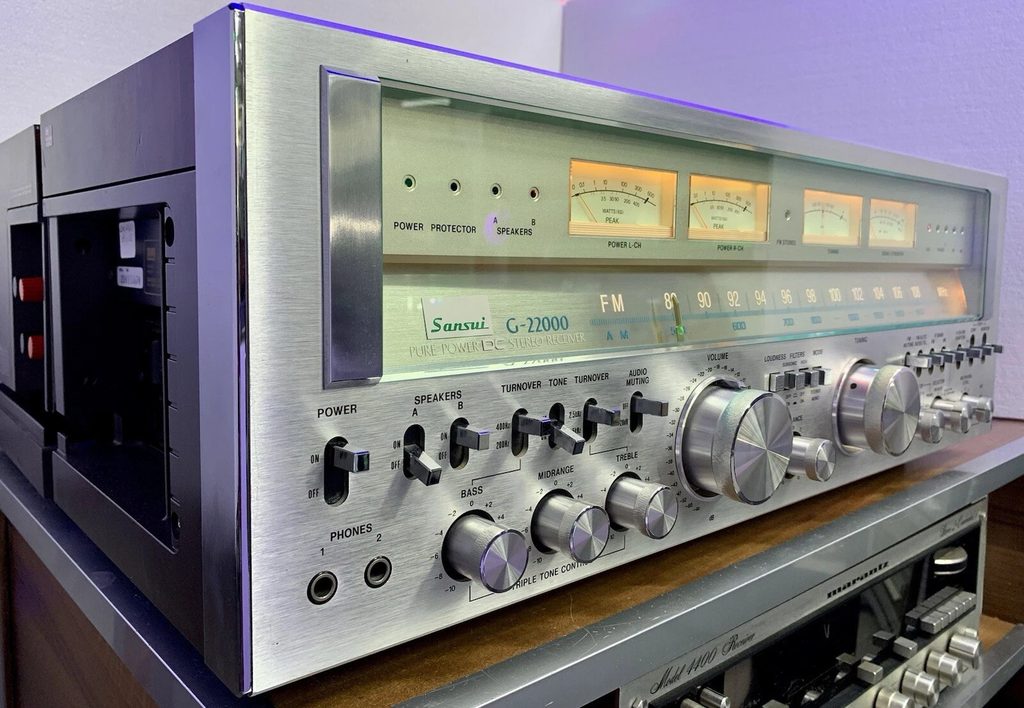
This may be the most misunderstood number in vintage audio.
You’ll see:
15 watts per channel.
50 watts per channel.
100 watts per channel.
160 watts per channel.
Naturally, you’d assume a 100-watt receiver must sound twice as loud as a 50-watt receiver.
It doesn’t.
To get roughly a 3 dB increase in maximum sound level with the same speakers, you generally need to double amplifier power.
So moving from 50 watts to 100 watts gives you additional headroom, but it doesn’t suddenly make the stereo sound twice as loud.
And here’s something even more important:
Watts don’t tell you how good an amplifier sounds.
They tell you something about how much electrical power the amplifier can deliver under specified conditions.
Speaker sensitivity, listening distance, room size, amplifier design, available current and how loudly you listen all matter.
That’s why a good 30-watt vintage receiver connected to efficient speakers can sound surprisingly powerful.
It also explains why the wattage wars of the 1970s became such a fascinating chapter in stereo history.
Manufacturers knew consumers understood one number:
MORE WATTS.
So everybody wanted more.
2. What Does Total Harmonic Distortion—THD—Actually Mean?
You’ll see specifications like:
THD: 0.1%
or:
THD: 0.03%
What does that mean?
In plain English:
How much harmonic content is the amplifier adding that wasn’t part of the original signal?
Imagine sending a perfectly clean musical signal into an amplifier.
Ideally, the amplified signal coming out would be an exact larger version.
Real amplifiers aren’t perfect.
They add tiny amounts of distortion.
THD is one way engineers measure part of that change.
But here’s where people get into trouble.
A receiver with 0.03% THD isn’t automatically “better sounding” than one with 0.08% THD.
Those numbers need context: frequency, output power, load, measurement method and the character of the distortion all matter.
THD is useful.
It just isn’t a musical quality score.
A specification sheet can tell you a lot about an amplifier.
It can’t tell you whether you’ll love listening to it.
3. What Do 2Ω, 4Ω, 6Ω and 8Ω Mean on Speakers?

Yamaha’s explanation of speaker impedance is a useful technical reference for understanding the relationship between speaker load, amplifier output and ohms.
This one scares people because it sounds like electrical engineering.
It doesn’t have to.
The Ω symbol means ohms.
On a speaker, the number refers to its nominal impedance—the electrical load the speaker presents to the amplifier.
Think of your receiver as an engine and the speakers as the hill you’re asking it to climb.
Generally, a lower-impedance speaker can demand more current from the amplifier.
Some amplifiers are built to handle that demanding load.
Others aren’t.
That’s why you can’t simply say:
“4-ohm speakers are better than 8-ohm speakers.”
They’re not.
They’re different loads.
And there’s another wrinkle.
A speaker labeled “8 ohms” isn’t necessarily exactly 8 ohms at every musical frequency. Its impedance changes with frequency.
The number on the back is a nominal rating.
That’s why you should pay attention to the speaker-impedance recommendations in the receiver’s manual.
Running a load that’s too demanding can make an amplifier run hotter, distort, trigger its protection circuitry or, in a worst-case situation, cause damage.
4. What Happens When I Use Speakers A + B at the Same Time?
Here’s one that has probably gotten more vintage receivers into trouble than people realize.
You’ve got two sets of speaker terminals:
A
and
B
So naturally you think:
“Why not run both?”
Sometimes you absolutely can.
But you need to understand what the receiver is seeing.
On many receivers, selecting A + B connects the two pairs in a way that effectively lowers the impedance presented to each amplifier channel.
For example, two nominal 8-ohm speakers connected in parallel can present a nominal 4-ohm combined load.
Two 4-ohm speakers in parallel?
Nominally, that’s 2 ohms.
Now your 50-year-old receiver may be climbing a much steeper hill.
That’s why the back panel or owner’s manual may specify different minimum speaker impedances when using A alone versus A + B.
Don’t guess.
Check the manual.
Your receiver will thank you.
5. Why Does a Turntable Need a Ground Wire When My Other Equipment Doesn’t?
Audio-Technica specifically instructs users to connect the turntable ground wire to help isolate ground loops or low-level hum.
You’ve probably wondered about this one.
Your CD player doesn’t have one.
Your cassette deck usually doesn’t have one.
Your tuner doesn’t have one.
Then you connect a turntable and suddenly there’s this skinny little wire that needs to be attached to a screw marked:
GND
Why?
Because the electrical signal coming from a typical phono cartridge is tiny compared with a normal line-level source.
Very tiny.
That signal then goes into a phono preamplifier, where it receives substantial amplification and the required RIAA equalization.
Unfortunately, unwanted hum can get amplified too.
The separate ground connection on many turntables helps establish the proper grounding arrangement between the turntable and phono stage and can prevent that familiar:
HMMMMMMMMMM.
Not every turntable requires a separate ground wire. Some designs incorporate grounding differently.
But on a turntable designed for one, forgetting that little wire can make a very big difference.
6. Why Can’t I Just Plug My Turntable Into AUX?
This is one of the most common mistakes made by people getting into vinyl.
A traditional turntable cartridge doesn’t normally produce a line-level signal like a CD player.
It’s much weaker.
It also needs a special frequency correction called RIAA equalization.
That’s what the PHONO section of your receiver provides.
Plug a traditional turntable directly into AUX and you’ll usually get sound that’s extremely quiet and tonally wrong.
But there’s an important modern exception.
Some turntables have a built-in phono preamp.
If the turntable is switched to LINE output, it can normally connect to AUX, CD, TAPE or another suitable line-level input.
And one more warning:
Don’t feed a turntable’s already-preamped LINE output into a traditional PHONO input unless the equipment specifically instructs you to do so.
You’re amplifying something that has already been amplified and equalized.
PHONO and AUX may look like identical RCA jacks.
Electrically, they’re doing very different jobs.
7. What Is Clipping—and Can It Really Damage My Speakers?
Yes.
And this is one every vintage stereo owner should understand.
An amplifier can only produce so much clean output.
Keep turning it up beyond that point and eventually the amplifier reaches its limits.
Instead of faithfully reproducing the peaks of the waveform, it begins flattening—or clipping—them.
The sound becomes harsh and distorted.
That’s your stereo trying to tell you something.
BACK OFF.
Severe clipping can create a signal with much more high-frequency energy than normal music and can contribute to driver damage, particularly tweeters.
This is why the statement:
“My speakers handle 150 watts, so my 50-watt receiver can’t hurt them.”
is dangerously simplistic.
A smaller amplifier driven deeply into clipping can absolutely create problems.
Likewise, an excessively powerful amplifier can damage speakers if they’re fed more power than they can tolerate.
The safest rule isn’t about matching one magic wattage number.
It’s this:
When the sound starts becoming harsh, compressed or obviously distorted, turn it down.
8. Why Does My Receiver Click a Few Seconds After I Turn It On?
I love this question because people hear that click for decades without knowing what it is.
You push POWER.
The dial lights up.
Nothing comes from the speakers.
Then…
CLICK.
And the music begins.
On many vintage receivers, that’s the speaker protection relay.
The protection circuit intentionally delays connecting the speakers while the amplifier’s circuits stabilize.
It may also disconnect the speakers if the protection circuitry detects a potentially dangerous condition.
So that little click you’ve heard thousands of times?
It’s not necessarily something going wrong.
Quite the opposite.
It’s often part of the receiver trying to protect your speakers.
And once you know what it is, you’ll never hear that click the same way again.
9. What Does “Recapped” Actually Mean?
This one matters enormously when buying vintage equipment.
You’ll see listings saying:
FULLY RECAPPED!
Sounds impressive.
But what exactly was done?
“Recapped” simply means capacitors were replaced.
The important questions are:
Which ones?
How many?
Why?
With what parts?
And what else was tested afterward?
A technician might replace a handful of known-problem capacitors and call the unit recapped.
Another restoration might involve replacing dozens of aging electrolytic capacitors, checking semiconductors, cleaning controls and switches, setting bias and offset where applicable, inspecting solder joints and thoroughly testing the unit afterward.
Those aren’t necessarily equivalent jobs.
And replacing every component simply because it’s old isn’t automatically good restoration either.
Quality parts.
Correct component selection.
Good workmanship.
Proper testing.
Those matter.
So when buying a “recapped” receiver, don’t be afraid to ask:
What exactly was replaced?
A good seller should be able to tell you.
10. Why Can a 50-Year-Old Receiver Still Sound So Damn Good?

Maybe this is the most important question of all.
How can something built when Gerald Ford or Jimmy Carter was president still sit in a living room today and absolutely fill it with music?
Part of the answer is engineering.
Large power transformers.
Substantial heat sinks.
Discrete components in many designs.
Serviceable construction.
Physical switches.
Real knobs.
Metal chassis.
But let’s not turn nostalgia into mythology.
Vintage equipment isn’t indestructible.
Capacitors age.
Switches oxidize.
Relays wear.
Transistors can become noisy.
Solder joints can fail.
Heat takes its toll.
A receiver surviving for fifty years doesn’t prove that everything old was built better than everything new.
It proves that some of this equipment was exceptionally well designed and built—and that repairable equipment can have an extraordinarily long life when people care enough to maintain it.
And maybe that’s the part I love most.
A modern disposable electronic device fails and we’re often expected to replace it.
A 1970s receiver develops a problem and somebody takes the cover off.
They diagnose it.
Repair it.
Clean it.
Adjust it.
Then put it back into service.
Another generation gets to hear it.
That’s more than nostalgia.
That’s preservation.
The Numbers Were Never the Whole Story
Watts matter.
Ohms matter.
THD matters.
Grounding matters.
Specifications matter.
But none of them individually tell you whether a stereo system will make you sit down and listen until two in the morning.
That’s where numbers stop.
And music begins.
Vintage stereo becomes much less intimidating once you understand what those numbers and strange terms actually mean.
And the more you understand the equipment, the easier it becomes to appreciate what the engineers who built it accomplished.
They weren’t building museum pieces.
They were building machines to play music.
Half a century later…
We’re still listening.
What Have You Always Wanted to Ask?
There’s no stupid vintage stereo question.
We all started somewhere.
Maybe you’ve always wondered why your receiver gets hot.
Maybe you don’t understand what DC offset means.
Maybe you want to know whether expensive speaker wire actually matters.
Maybe you’ve wondered what that mysterious LOUDNESS button actually does.
Ask me below.
Your question might become Part Two of Vintage Stereo Explained.
Rock on, my friend 🤘🏻