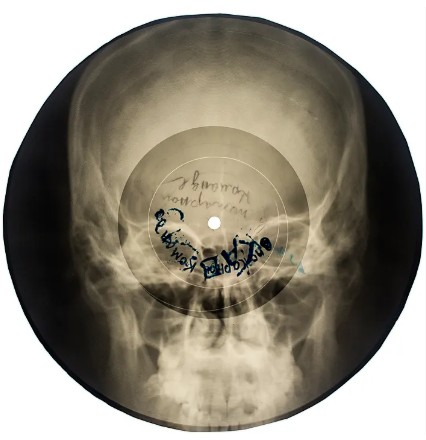
The forgotten story of forbidden music, Soviet censorship, and the people who refused to stop listening.
Imagine being sixteen years old in the Soviet Union in the 1950s.
You’ve heard rumors about an American singer named Elvis Presley.
You’ve heard whispers about jazz musicians whose records aren’t sold in your local stores.
Somewhere, somebody has a recording of music you’re not supposed to hear.
You want it.
But there’s no record store where you can simply walk in and buy it.
So a friend quietly hands you something strange.
It’s round.
Thin.
Flexible.
And when you hold it up to the light, you see something that makes absolutely no sense.
A human rib cage.
Someone has taken an old medical X-ray, cut it into the shape of a record, and carved music into its surface.
You place it on a turntable.
Lower the needle.
And suddenly, music that the government tried to keep out of your life fills the room.
Welcome to the extraordinary world of bone records.
What Were Bone Records?
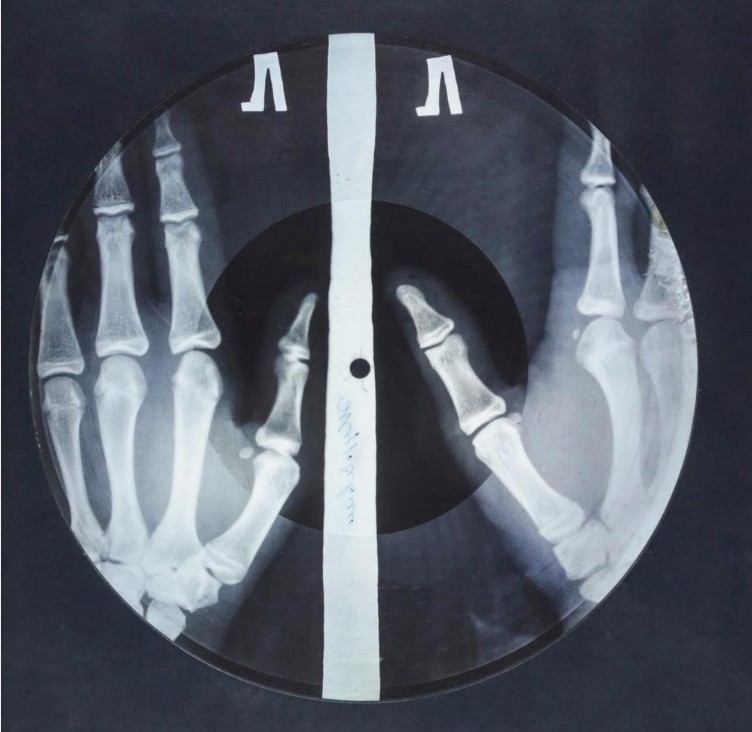
Bone records, also called ribs, bone music, or roentgenizdat, were underground recordings produced in the Soviet Union primarily from the late 1940s through the early 1960s.
They weren’t made from conventional vinyl.
They were made from discarded medical X-ray film.
Actual hospital X-rays.
Images of broken arms, rib cages, skulls, lungs, and other parts of the human body became the unlikely surfaces on which forbidden music was preserved.
The recordings could be played on gramophones or record players, although their sound quality and durability were generally poor.
But sound quality wasn’t the point.
Having the music at all was the point.
Why Was the Music Forbidden?
During the Cold War, Soviet authorities exercised extensive control over recorded music and the cultural influences reaching the public.
Certain Western musical styles, performers, and recordings were condemned as ideologically unacceptable.
But this wasn’t simply a story about American rock and roll.
Some of the most sought-after underground recordings featured Russian émigré singers, sentimental romances, prison ballads, criminal folklore, and other music that authorities considered undesirable.
Artists such as Alexander Vertinsky and Pyotr Leshchenko became important names in this hidden musical world.
Later, Western jazz and rock and roll helped fuel the demand.
Ella Fitzgerald.
Bill Haley.
Elvis Presley.
To young people fascinated by unfamiliar sounds, these recordings represented something they couldn’t easily find in officially approved culture.
A connection to another world.
And sometimes, to a part of their own culture that had been suppressed.
How Did They Turn X-Rays Into Records?
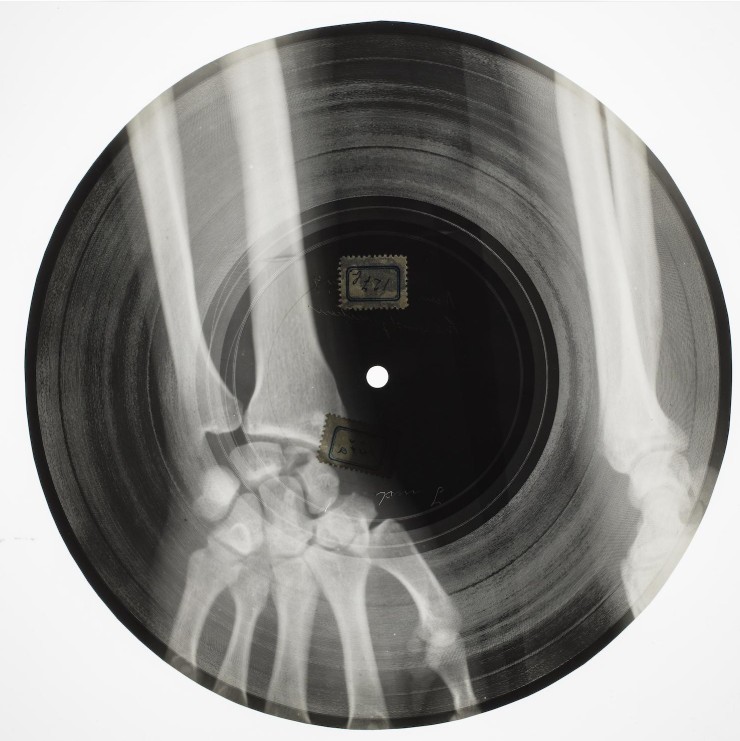
https://www.x-rayaudio.com/x-rayaudiohistory
Here’s where the story becomes almost unbelievable.
The underground record makers needed two things.
A machine capable of cutting sound grooves.
And something to cut those grooves into.
Conventional recording materials were difficult to obtain because the state controlled record production.
But discarded medical X-ray film offered an ingenious alternative.
Underground technicians adapted or built recording lathes capable of cutting grooves into the flexible film.
The process was remarkably resourceful.
- Obtain discarded X-ray sheets from hospitals or clinics.
- Cut the sheets into circular discs.
- Make a spindle hole near the center.
- Use a recording lathe to cut an audio groove into the surface.
- Distribute the finished record through underground networks.
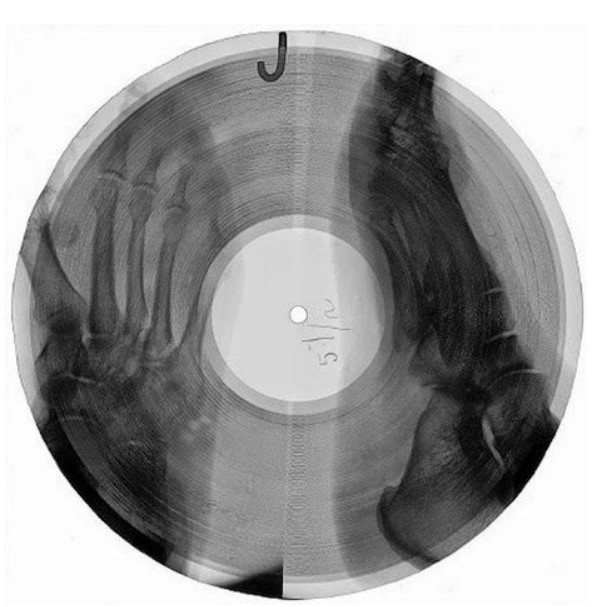
Some surviving examples still show the unmistakable outline of a human skeleton beneath the grooves.
Think about that for a moment.
An X-ray taken to diagnose somebody’s injury might eventually carry a jazz performance into a stranger’s living room.
A picture of a broken bone became a way of carrying forbidden sound.
The Men Who Helped Start the Underground Revolution
One of the earliest centers of bone-record production was Leningrad, now Saint Petersburg.
In the years following World War II, Ruslan Bugaslovski and Boris Taigin helped pioneer the practice of copying music onto discarded X-ray film.
They adapted recording equipment using available parts and created a way to duplicate recordings outside the official Soviet record industry.
Their work helped inspire others.
As underground networks expanded, bone records appeared in Moscow and other Soviet cities.
Some people made them for money.
Some made them for friends.
Others were motivated by their love of music.
But this was never an ordinary record business.
The authorities could punish people involved in producing and distributing prohibited recordings.
Bugaslovski himself was imprisoned multiple times.
Imagine risking your freedom because you believed somebody deserved to hear a song.
What Did Bone Records Actually Sound Like?
Here’s something that might surprise modern vinyl collectors.
They usually didn’t sound very good.
The flexible material wasn’t comparable to a professionally manufactured record.
Surface noise was common.
Distortion could be substantial.
The grooves wore quickly.
Some recordings lasted only a handful of plays before deteriorating significantly.
And yet people kept buying them.
Why?
Because the choice wasn’t between a bone record and a pristine audiophile pressing.
The choice was often between a bone record…
And no recording at all.
Today we debate cartridges, stylus profiles, phono stages, speaker placement, and whether one amplifier sounds warmer than another.
These people were just trying to hear the music.
It puts our modern audio arguments into perspective.
Was It Mostly Folk Music?
Not exactly.
This is one of the most interesting misunderstandings surrounding bone records.
They weren’t exclusively Western rock and roll records, but they weren’t simply traditional folk recordings either.
Early underground recordings included Russian émigré songs, romances, criminal ballads, and music that reflected traditions excluded from official Soviet cultural life.
Western jazz and later rock and roll were also significant parts of the underground market.
The balance varied by period, place, and audience.
In fact, researchers of the X-Ray Audio Project have emphasized that the Russian-language material was central to the history, even though Elvis Presley and Western jazz often dominate modern retellings.
That’s what makes the story even more powerful.
Bone records weren’t just a way to hear American music.
They were a way to hear music that somebody else had decided you shouldn’t hear.
The Young Rebels Who Wanted Something Different
The Soviet Union had its own youth subculture fascinated by Western music and fashion.
They were called the stilyagi.
They embraced distinctive clothing, hairstyles, dancing, jazz, and eventually rock and roll.
Their interests challenged expectations about how Soviet young people should look and behave.
And music was an important part of that identity.
Imagine the excitement of hearing Bill Haley’s “Rock Around the Clock” for the first time when obtaining the recording required knowing the right person.
Today that song is available almost instantly.
Back then, access itself could feel extraordinary.
The record wasn’t just entertainment.
It was a connection to a culture beyond the official boundaries.
Why Did Bone Records Disappear?
Bone records flourished because demand for certain music existed alongside severe restrictions on access to conventional recordings.
But the format had limitations.
The discs were fragile.
The sound quality was inconsistent.
The authorities pursued underground producers and sellers.
And as other recording technologies and copying methods became more accessible, the need for X-ray discs diminished.
By the 1960s, the extraordinary era of music recorded on medical film was drawing to a close.
Most bone records were never intended to survive for generations.
They were inexpensive, improvised, and disposable.
Many were worn out and discarded.
Which makes the surviving examples all the more remarkable.
The Man Who Helped Bring Bone Music Back to Life
Decades later, British musician and researcher Stephen Coates encountered an unusual record at a market in Saint Petersburg.
It was an X-ray recording.
His curiosity eventually helped launch the X-Ray Audio Project, dedicated to researching, documenting, and preserving this forgotten chapter of recorded music.
Through interviews, photographs, exhibitions, books, and surviving audio recordings, the project has helped bring the stories of the original underground record makers to a much wider audience.
Today, you can see genuine examples of these extraordinary discs and even hear surviving recordings.
The X-Ray Audio Project has turned what might have remained a forgotten curiosity into an important story about music, technology, censorship, and human ingenuity.
What Bone Records Teach Us About Music
I spend a great deal of time around vintage stereo equipment.
Receivers.
Turntables.
Speakers.
Cassette decks.
Machines built by engineers who cared deeply about reproducing music.
And I love every bit of it.
But bone records remind us of something important.
The equipment was never the ultimate reason we listened.
The music was.
The emotions.
The memories.
The feeling of hearing something that reaches a part of you nothing else can touch.
A bone record could sound terrible.
It could wear out after only a few plays.
It might look like something rescued from a hospital trash can.
But to the person who finally got to hear that forbidden song?
It could mean everything.
From X-Ray Records to Unlimited Streaming
Think about the difference between then and now.
Today, millions of songs are available almost instantly.
We can listen to music in our cars, through headphones, on our phones, or throughout our homes.
We skip songs after fifteen seconds.
We build playlists containing more music than we could listen to in a lifetime.
And sometimes we barely pay attention.
But there was a time when someone might spend days searching for a recording.
Risk punishment to obtain it.
Bring it home.
Carefully place it on a turntable.
And listen as though every second mattered.
Because it did.
Maybe that’s one of the greatest lessons hidden inside these strange little discs.
When music is difficult to obtain, we sometimes discover just how much it means to us.
Final Thought: Music Finds a Way
Governments can restrict records.
They can control factories.
They can censor radio stations.
They can punish the people who distribute forbidden songs.
But history shows how difficult it is to eliminate the human desire to hear music.
When Soviet music lovers couldn’t obtain conventional records, they found another way.
They turned hospital X-rays into gramophone discs.
They transformed pictures of broken bones into carriers of music.
And they left behind one of the strangest, most moving chapters in the history of recorded sound.
The records were fragile.
The recordings were imperfect.
But the desire behind them was anything but weak.
They didn’t have the freedom to buy the music they loved.
So they found a way to make it themselves.
And more than seventy years later, we’re still talking about it.
Rock on, my friend 🤘🏻
I’d Love to Hear Your Thoughts
Imagine being told you weren’t allowed to listen to your favorite band.
Would you have taken the risk to get the record?
And if you could preserve just one song on a bone record, which song would it be?
Share your answer below.
I’d love to know what music means enough to you that you’d refuse to give it up.